
Random Post: AGBT Day 1: Illumina Shines
RSS 2.0
  • Home
  • About
  • Aligners
  • Genomes
  • VarScan
  •  

    Whole Genome Sequencing Diagnostics

    March 24th, 2010
    bcm nejmlogo

    This month in the New England Journal of Medicine, James Lupski and colleagues sequenced the complete genome of an individual with familial Charcot-Marie Tooth (CMT) disease. The “individual” is Lupski himself – he not only led the study, but served as patient zero. From conversations with some of my colleagues at Baylor, it’s clear that Dr. Lupski has devoted much of his career to understanding CMT disease; his association with one of the big three genome centers was the driving force behind this project.

    The clinical background is rather interesting. Dr. Lupski and three of his siblings were diagnosed with CMT that appeared to be autosomal recessive, since their parents and grandparents were unaffected. Intriguingly, however, their father and paternal grandmother both shared a less severe disorder, axonal neuropathy, that would later prove to arise from haploinsufficiency in the CMT disease-causing gene.

    Why Must There Always Be A Problem?

    CMT, like many Mendelian disorders, has proven to be a genetically heterogeneous disease. It can segregate in an autosomal dominant, recessive, or X-linked manner. Single nucleotide polymorphisms (SNPs) and/or copy number variants (CNVs) at some 39 loci confer susceptibility to the disease. However, when tested for some of the more common CMT gene mutations (PMP22, MPZ, PRX, GDAP1, and EGR2), the causative variant for the Lupski pedigree was not found.

    Although his institution (BCM) is a leader in exome capture and sequencing, Lupski and colleagues decided on a whole-genome sequencing approach. It was probable, but not certain, that the disease-causing variant was in a coding region, and it might also have been a copy number change which wouldn’t be detected using a capture approach. Thus, with about four runs on a Life Technologies SOLiD instrument, the Lupski genome at 30x was revealed.

    Finding the Causative Variants

    There were something like 3.4 million SNPs and small indels, which is right on the money for WGS of a single individual, but terribly daunting when searching for a single mutation. The authors whittled down the list of suspects in a series of steps: first they isolated intragenic variants (1.17 million), then prioritized nonsynonymous variants (9,069), and finally cross-referenced these with the ~40 genes linked to CMT (54 coding SNPs). Intriguingly, two of the 54 SNPs were in SH3TC2, a gene previously implicated in CMT in eastern European families. One, carried by Dr. Lupski’s mother, was a known nonsense mutation. The other, carried by his father and paternal grandmother, was a novel missense change that segregated with axonal neuropathy in the pedigree.

    Sequencing and Disease Pedigrees

    The authors rightly conclude that this study demonstrates the diagnostic power of whole genome sequencing, and that “as a practical matter, the identification of rare, heterogeneous alleles by means of whole-genome sequencing may be the only way to definitively determine genetic contributions to the associated clinical phenotypes.” Another important take-home message from this study, however, is the critical importance of large, well-characterized pedigrees for the study of inherited disease. Indeed, in the absence of exhaustive functional validation, the best way to confirm that you’ve found the disease-causing mutation is to show that it segregates with the phenotype in the rest of the pedigree.

    Perhaps the most important aspect of this study is the venue – the New England Journal – because it, like our study of AML2 last year, demonstrates the power of next-generation sequencing to a different audience: the clinicians and medical practitioners who interact directly with patients.

    References

    Lupski JR, Reid JG, Gonzaga-Jauregui C, Rio Deiros D, Chen DC, Nazareth L, Bainbridge M, Dinh H, Jing C, Wheeler DA, McGuire AL, Zhang F, Stankiewicz P, Halperin JJ, Yang C, Gehman C, Guo D, Irikat RK, Tom W, Fantin NJ, Muzny DM, & Gibbs RA (2010). Whole-Genome Sequencing in a Patient with Charcot-Marie-Tooth Neuropathy. The New England journal of medicine PMID: 20220177

    AddThis Social Bookmark Button

    Next-Gen Sequencing in 2010

    March 9th, 2010

    seq-logo-collage

    On the shuttle from Marco Island to the airport last week, I happened to sit next to a very nice gentleman from Illumina. We got to talking, of course, and I asked him if they saw a threat from any of the new sequencing platforms presented at AGBT. I’m aware that Illumina currently enjoys a greater-than-50% share of the next-gen sequencing market, so I was curious about his impressions.

    “We definitely see a segmentation of the market,” he admitted.

    Something had been bothering me about the sequencing-company presentations this year, and I finally realized what it was.  During AGBT 2009, every player was gunning to take over the world. This year it seems like every sequencing platform has a niche in mind.

    General Sequencing: Illumina vs. Life Technologies

    Illumina’s HiSeq2000 and Life Tech’s SOLiD 4 are after the general sequencing market – whole genome, transcriptome, and targeted (capture) sequencing.  It’s a constant game of one-upmanship in throughput and claimed accuracy.  In February this year, Illumina launched the HiSeq2000 with expected throughput of 200 GB per run. Life Technologies launched SOLiD 4 with 100 GB per run, but promised 300GB per run later this year. On the read length front, Illumina remains the clear winner – 2×100 is in production at many genome centers, and even longer reads have been promised. Life Tech, to their credit, is pushing the SOLiD 4 platform pretty hard.

    When Length Matters: 454

    Roche/454 has wisely backed away from large-scale sequencing, and instead seems to be targeting applications where longer (450 bp) reads are a requirement. At AGBT, Henry Erlich (Roche) gave an interesting talk about genotyping and haplotyping human HLA regions to improve donor matching for organ transplants.  Here’s a key challenge of modern medicine where sequencing can offer tangible benefits.  Here at the genome center, we use 454 runs for validation and for small-scale targeted sequencing. There are many applications where relatively inexpensive long-read sequencing runs are idea; full-length cDNA sequencing, for example, comes to mind.

    Complete Genomics: Sequencing as a Service

    The business model of Complete Genomics seems a bit of a gamble to me. They aim to be the provider of relatively inexpensive, start-to-finish sequencing services. No technology or reagent sales for these guys. Instead, they want to take your samples and give you back the SNPs. In the coming years, they hope to build as many as 10 facilities throughout the world that provide these services. I’m a bit leery of Complete Genomics, not only because their proprietary technology lags behind others (currently it’s at 2X35 bp), but because they’ll need to do something like 10,000 genomes a year just to stay in business. I don’t think we’re ready for that.

    Sequencing for the Masses: IonTorrent

    Many of us were impressed by IonTorrent this year at AGBT. The incredibly low cost of their instrument ($50K) and sequencing runs ($300-500) mean that nearly any lab could write a grant around this technology. The sample prep, accuracy, and throughput are still a grey area, but if they prove to be good enough, high-throughput sequencing will suddenly be available to just about everyone.

    Single Molecule Applications: Pac Bio and Oxford Nanopore

    The true single-molecule sequencing platforms that are close to market are certainly getting everyone excited. In the next few years, however, it’s unlikely that Pacific Biosciences, Oxford Nanopore, mystery-Chinese-platform, or other companies will displace massively parallel sequencing. No, I think Illumina and SOLiD will remain the “work horses” for discovery, certainly at major genome centers. Where SMS technologies can excel, however, is ultra-long reads – think about PacBio’s strobe sequencing to resolve structural variation or finish assemblies – and lots of molecule-kinetics stuff that I don’t understand.

    I think that 2010 will be an exciting and telling time for all of these platforms. In a year’s time, we should have results in hand from HiSeq, SOLiD4, PacBio, and even IonTorrent, and be able to distinguish between marketing claims and sequencing reality.

    AddThis Social Bookmark Button

    AGBT: Ion Torrent Wows with Semiconductor Sequencing

    March 1st, 2010

    logo

    In the last session of AGBT 2010, new player Ion Torrent impressed the crowd with a low-cost sequencing platform that uses a silicon chip to sequence DNA. The principle, for once, is easy to understand: a silicon chip printed with millions of tiny semiconductor wells. In each well, when DNA polymerase adds a base to the template strand, a hydrogen ion is released. It hits a pH detector in the bottom of the well, and the pH change is recorded digitally. Multiple incorporations cause linear increases in the pH change, so homopolymers should be less of a problem than 454. It operates on native DNA, without any of the reagents, dyes, and other complicating aspects of other sequencing technologies.

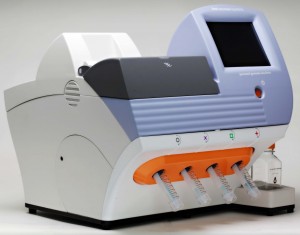
    ion-torrent-sequencerSo, can I take a picture of that?

    During my tour of the Ion Torrent suite, I saw just how simple and straightforward the machine was.

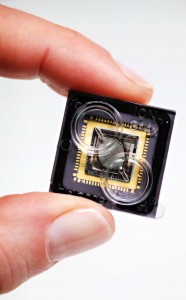
    It’s slightly larger than a bread box. When opened, it’s little more than a motherboard with a few wires running into it. The real engineering marvel is the semiconductor chip itself (below left), which is tiny and packed with about 1.5 million pH-sensitive wells.

    It seems to me that the chip and the motherboard are the heart of the instrument, so obviously, I asked if I could take a photo. The Ion Torrent representative, a Mr. Garrick, politely (and obviously) said that I could not.

    However, to their credit: within hours, I had an e-mail from IonTorrent’s PR agency providing me with some exclusive photos of the equipment. They’re scattered throughout this post. I actually can’t guarantee that they’re exclusive, but I was happy to have something.

    Post-Light Sequencing with Semiconductor Chips

    Jonathan Rothberg, CSO of Ion Torrent, gave the final presentation of AGBT 2010. In my opinion, which was shared by several attendees, the talk was a disappointment.

    chip-in-hand3

    Rothberg is obviously a brilliant guy, but he lacks the polish of Eric Schadt (PacBio) and Joseph Beecham (Life Tech), who gave talks right before him.

    Instead, the speaker went on and on about the $90 billion investment in the semiconductor industry that enabled the design of the IonTorrent chip, which can be manufactured in virtually any CMOS facility. This is an important strength for the technology, because competition among manufacturers will drive the cost down.

    He called it “Steve Jobs meets Gordon Moore” and in some ways he’s right – Ion Torrent may very well make sequencing accessible to just about everyone. But Rothberg failed to mention a few salient points concerning the Ion Torrent technology, and he shrugged off an attendee’s question about sample prep (“If I tell you about that, you won’t come to my next talk.”).

    Not the answer the audience wanted.

    IonTorrent: What You Need To Know

    What I learned in the Ion Torrent suite impressed me far more than Rothberg did. The most salient points were:

    • Low cost. The instrument is tentatively priced at $45K, and disposables (chips) are $500 per run.
    • Throughput. The standard chip, called the 314, contains 1.5 million wells. It’s one read per well, but importantly (and glossed over by Rothberg), they expect ~50% of wells to be filled. That’s 750,000 reads; at the current read length (100 bp), we’re talking 75 Mbp per run.
    • Run time. The claim is one hour, but conversations with people who run the instrument reveal that it’s more like two hours.  That’s still a very quick turnaround. No word on whether run time will increase with longer reads.
    • Coming improvements. There’s already a new chip design (the 316) which packs in 7.3 million wells, more than quadrupling the sequence throughput. Ion Torrent representatives continually assured me that, to this point, they’ve only focused on getting the machine to work, and haven’t yet begun to tweak the chemistry or other aspects that could improve performance.
    • Ipod and app included. I can’t believe that Rothberg didn’t mention this – an iPod Touch ships with each instrument, pre-installed with an app to monitor runs and cycles in real time. How cool is that?

    Many at AGBT, like me, were less excited about IonTorrent immediately after Rothberg’s talk. However, hours later, the excitement seemed to work its way up. Aaron Quinlan (UVA) said that he was impressed because this is a technology that a small lab can write an R01 grant around. Vince Magrini (WashU) wondered if the CSHL sequencing course might one day feature one IonTorrent instrument per student. Ion Torrent certainly has a niche pretty much to themselves, so I think this is a company to watch.

    AddThis Social Bookmark Button