Random Post: Genomes
RSS 2.0
  • Home
  • About
  • Aligners
  • Genomes
  • Subscribe
  • VarScan
  •  

    A Promising New Drug for Cystic Fibrosis

    February 24th, 2011

    Contents: CFTR GeneMutation ClassesVertex Vx-770 DrugOther Drugs for CF Mutations Three Excellent Books on CF

    Today I got a call from a patient with cystic fibrosis, asking if I knew much about a specific mutation called 2184-del-A. It was a striking conversation, particularly because I tend to envision about infants and young children when I think about CF, and this woman was clearly an adult, a working professional, who had some knowledge of her own disease and wanted to know more. She’s particularly interested because of today’s announcement from the CF Foundation and Vertex Pharmaceuticals on the results of a Phase 3 clinical trial for a new CF drug, VX-770. The claim: a significant improvement in lung function among CF patients with the G551D mutation.

    For years, I have been occasionally mistaken as a CF expert by non-scientists. This confusion stems from a journal club on the genetics of CF that I gave in graduate school; if you search for “genetics of cystic fibrosis”, my presentation of a 2003 review in Lancet, comes up #5.

    The Cystic Fibrosis Transmembrane Conductor (CFTR) Gene

    The CFTR gene encodes a protein in the ATP-Binding Cassette (ABC) family, whose members transport molecules across extracellular (between cell and environment) and intracellular (between compartments within a cell) membranes. The CFTR protein serves as a channel for chloride ions and is important for the creation of sweat and mucus.

    cftr gene


    Classes of Disease-Causing Mutations

    According to the Cystic Fibrosis Mutation Database, more than 1,800 mutations have been described in CFTR, the gene implicated in cystic fibrosis. CFTR encodes the cystic fibrosis transmembrane conductance regulator, a chloride channel that transports ions across extra- and intra-cellular membranes.

    Traditionally, CFTR mutations are divided into six classes based on their probable effect.

    • Class I mutations lead to defective protein products
    • Class II mutations result in defective protein processing
    • Class III mutations have a defect in the channel regulation
    • Class IV mutations are defective in conductance through the channel
    • Class V mutations of abnormal splicing.
    • Class VI mutations have unknown effects.

    Unfortunately, 2184-del-A is in the last category, a mutation of unknown effect. However, a literature search, followed by my own analysis, reveals that the deletion introduces a frameshift at residue 684 and early termination (p.Lys684AsnfsX38). The encoded protein would be severely truncated, with less than half of its 1,480 amino acids. Thus, I suspect that 2184-del-A may represent a class I mutation.

    Gating Mutations and VX-770

    Class III and IV mutations are typically associated with milder disease, indicating that some channel function remains. The class III mutation targeted by Vertex’s drug (G551D), encodes a protein with a gating defect; it localizes to the membrane, but its channel is unable to use ATP to speed ion transport. VX-770 helps open the gate at the cell surface, allowing chloride ions to flow through. In the Phase 3 trial, patients receiving the drug had improved lung function and reduced sweat chloride levels, suggesting that the drug is treating the underlying defect.

    Other Drugs, Other Mutations

    G551D is the third most common mutation, affecting something like 4% of patients. For patients homozygous for “delta-508″, the most common CF mutation, Vertex has another drug in the pipeline. Called VX-809, this drug acts by getting more of the CFTR protein to the cell surface. A phase 2 clinical trial of combined VX-809 and VX-770 treatment in delta-508 patients is currently under way.

    Given the diversity of CF-causing mutations, designing drugs for one mutation subset at a time seems like a painful process. But considering that CFTR was the first disease gene isolated, it’s refreshing, at least, to see real progress on the path to curing this disease. I know at least one patient who’s pretty excited about it.


    Three Excellent Books on Cystic Fibrosis

    If you’d like to learn more about cystic fibrosis research, management, and living with the disease, here are some books I’d recommend to you.

    Cystic Fibrosis: A Guide for Patient and Family by David Orenstein, Jonathan E. Spahr, and Daniel J. Weiner
    This is the current definitive resource for people living with cystic fibrosis. It explains the disease process, outlines the fundamentals of diagnosing and screening, and addresses the challenges of treatment.
    Alex: The Life of a Child by Frank Deford
    The poignant and uplifting story of Alexandra Deford, a precious and precocious girl, was just eight years old when she died of cystic fibrosis in 1980.
    Little Brave Ones: For Children Who Battle Cystic Fibrosis by Carrie Lux
    A picture book telling the story of one day in the life of a girl with cystic fibrosis. This book’s intended audience is children with CF, to show them that they’re not alone in having to do daily treatments, take numerous medicines, and have hospital stays.

    References
    Bompadre, S., Sohma, Y., Li, M., & Hwang, T. (2007). G551D and G1349D, Two CF-associated Mutations in the Signature Sequences of CFTR, Exhibit Distinct Gating Defects The Journal of General Physiology, 129 (4), 285-298 DOI: 10.1085/jgp.200609667
    AddThis Social Bookmark Button

    Chromothripsis and Cancer

    February 17th, 2011

    The traditional cancer paradigm is one of progressive disease, in which cells gradually accumulate genomic rearrangements and point mutations over years (or decades), resulting in incremental progression through a series of increasingly malignant stages. New research has challenged that model. Using next-generation sequencing, Stephens et al have characterized a phenomenon in which tens to hundreds of rearrangements occur in a one-time cellular crisis.

    The study comes from a group (led by Michael Stratton, Andrew Futreal, and Peter Cambpell) at the Sanger Institute that has pioneered the use of massively parallel paired-end sequencing to identify structural rearrangements in tumor genomes. During a rearrangement screen of ten patients with chronic lymphocytic leukemia (CLL), they identified one patient whose pattern of rearrangements was quite striking.

    Massive but Localized Chromosome Remodeling

    Over forty rearrangements affected a single chromosome (4q). The copy number across this segment oscillated between 2 (diploid segments with normal heterozygosity) and 1 (haploid segments with LOH). Interestingly, the latter regions did not result from simple deletions. There were breakpoints and copy number changes for deletions, duplications, and inversions. Although the breakpoints were markedly clustered, they joined segments that normally were not proximal to one another. Some were normally megabases apart. It was as if the chromosome were broken up to pieces and put back in random order.

    That, as it turns out, is probably what happened.

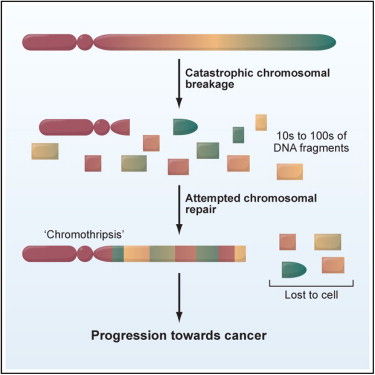
    chromothripsis

    The patient was a treatment-naive, 62-year-old woman with CLL. She underwent chemo with alemtuzumab, but relapsed quickly. A sample of the relapse had the same rearrangements, but no new ones, suggesting that the process responsible for this phenomenon was not ongoing. Indeed, all evidence suggested that this was a one-time cellular crisis that the authors called “chromothripsis” – Greek for “chromosome shattering into pieces.”

    The Chromothripsis Model, or Humpty-Dumpty

    The proposed model suggests that a chromosome was literally broken into hundreds of pieces, likely while in its condensed state during mitosis. Humpty-Dumpty time. When this happened, the cellular DNA repair machinery (all the King’s men) responded, stitching the pieces back together as best it could. Some segments are rescued, assembled in random order (by non-homologous end-joining) into a derivative chromosome. Other segments are lost. This would explain the oscillating pattern of copy number and heterozygosity. Successfully “rescued” segments in the derivative chromosome would retain their heterozygosity and have a diploid copy number of 2. Lost segments would have LOH and a copy number of 1.

    Recurrence in 2-3% of Human Cancers

    To determine if this phenomenon was common in human cancers, the authors analyzed SNP array-based copy number profiles of 746 cancer cell lines. Of these, 18 (2.4%) exhibited the stamp of chromothripsis – frequent copy number changes in a localized region oscillating between one, two, and occasionally three states. Intriguingly, these cell lines represented numerous tumor types: melanoma, small-cell and NSC lung cancer, hematological malignancies, synovial sarcoma, and colorectal, esophageal, and thyroid cancer. Four cell lines were selected for paired-end sequencing and cytogenetics; only three are presented, though, because the fourth will be “described later” (apparently the authors plan to double-dip on publication).

    A One-Off Cellular Crisis

    Using the data from these three cell lines and some impressive Monte Carlo simulations, the authors demonstrate that the majority of rearrangements in each sample did not arise gradually over numerous cell divisions. Rather, they were the result of a massive but localized cellular crisis, one that likely occurred early in cancer development.

    What could be the cause of such an event? The authors offer two interesting possibilities. A pulse of ionizing radiation, which is well known to cause double-stranded breaks, might have cut a swath through a chromosome condensed for mitosis. Another possibility is the breakage-fusion-bridge cycle that occurs with telomere attrition. Several of the observed chromothripses (?) extended into the telomere, which might support this explanation.

    No matter how it happens, one expects that the vast majority of cells undergoing this crisis would die. A cell might survive, however, and the newly-rearranged chromosome could confer some advantages that promote malignancy – for example, loss of tumor suppressor genes, amplification of oncogenes, and dysregulation of gene expression. Chromothripsis, therefore, may provide a considerable leap towards cancer development.

    Taken together, the results of this study suggest that 2-3% of all human cancers show evidence for tens to hundreds of structural rearrangements from a single catastrophic event. More studies are needed to understand the causes of this remarkable phenomenon, and the role it may play in cancer development and progression.

    For more, have a look at Keith Robison’s very nice post on this study at his blog, Omics! Omics!

    References
    Stephens PJ, Greenman CD, Fu B, Yang F, Bignell GR, Mudie LJ, Pleasance ED, Lau KW, Beare D, Stebbings LA, McLaren S, Lin ML, McBride DJ, Varela I, Nik-Zainal S, Leroy C, Jia M, Menzies A, Butler AP, Teague JW, Quail MA, Burton J, Swerdlow H, Carter NP, Morsberger LA, Iacobuzio-Donahue C, Follows GA, Green AR, Flanagan AM, Stratton MR, Futreal PA, & Campbell PJ (2011). Massive genomic rearrangement acquired in a single catastrophic event during cancer development. Cell, 144 (1), 27-40 PMID: 21215367

    AddThis Social Bookmark Button

    Less Is More: Sequencing on the Benchtop

    February 7th, 2011

    The arms race of sequencing has always been about throughput. The big players (Illumina and Life Tech technologies) have engaged in a continual game of one-upmanship over the last few years. As a result, we’ve seen yields skyrocket to from 10 gigabases per run to the current and outrageous 180-200 gb on the HiSeq. Good news for the sequencing centers, if not for their hapless bioinformaticians.

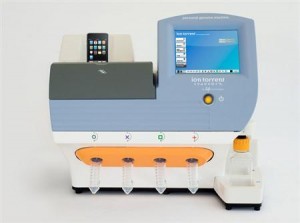
    iontorrentappurtenaforbes

    IonTorrent's PGM

    Now the focus seems to be shifting. Not every lab can afford a half-million-dollar instrument. Those that can likely have already bought them, which means that to make another sale, vendors must promise more than just marginal throughput gains. Last year at AGBT, we saw a new company enter the market with the equivalent of a surprise lob. Small-ball, if you will. IonTorrent promised a benchtop sequencer with short run times and appreciable read lengths (100bp) for under $50K.

    The strategy was obvious: bring sequencing to the masses at a price most labs could afford. We’re talking about a completely different market here with almost no penetration: single investigators, small labs, even university departments. A new battleground for sequencing.

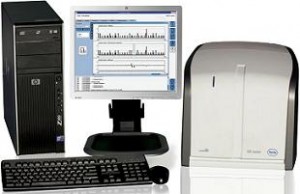
    454 GS Junior

    454 GS Junior

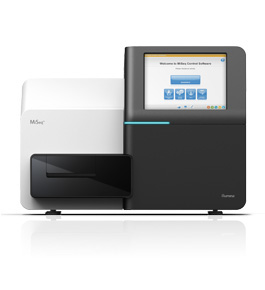
    And in the year that followed, three companies made a play. Roche/454 launched the GS Junior, which is just adorable. Life Technologies acquired IonTorrent. And the current hegemon, Illumina, promised a small-scale version of their flagship sequencing platform: the MiSeq Personal Sequencing System.

    Vendor: IonTorrent (Life) 454 (Roche) Illumina
    Platform: PGM GS Junior MiSeq
    Technology: Semiconductor sequencing Pyrosequencing Sequencing-by-synthesis
    Read Length:
    100 bp 400 bp 1×35 bp
    2×100 bp
    2×150 bp
    Run Time: 1-2 hours 10 hours 4 hours
    19 hours
    27 hours
    Output: 10 mbp 35 mbp 120 mbp
    680 mbp
    1 gbp
    Illumina's MiSeq

    Illumina's MiSeq

    The specs I’ve compiled above are from the company web sites and brochures. The new instruments seem to share a theme: smaller footprints, lower price tags, and run times lasting less than a day. While not suitable for whole-genome or even whole-exome sequencing, these platforms have dozens of other applications: microbial genomes, BACs or cDNAs, targeted (PCR) validation of mutations or structural validation. Heck, it should even be possible to merge the output of these sequencers with whole-genome or exome BAM files.

    One thing is clear: this trend will quickly put next-generation sequencing into the hands of just about every investigator who’d like one. And I find that very exciting.

    References
    Zhao J, & Grant SF (2010). Advances in Whole Genome Sequencing Technology. Current pharmaceutical biotechnology PMID: 21050163

    AddThis Social Bookmark Button