Random Post: Subscribe
RSS 2.0
  • Home
  • About
  • Aligners
  • Genomes
  • Subscribe
  • VarScan
  •  

    A virus-associated liver cancer genome

    May 27th, 2011

    In Nature Genetics last month, Yasushi Totoki and colleagues present the high-resolution characterization of hepatocellular carcinoma (HCC), the third most frequent cause of cancer-related death worldwide. The authors performed whole-genome sequencing (Illumina 2×50 bp) of the primary tumor (36x) and matched lymphocytes (28x) from a Japanese male with hepatitis C virus-positive liver cancer.
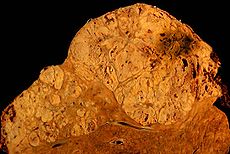
    HCV-positive HCC tumor (Wikipedia)

    HCV-positive HCC tumor (Wikipedia)

    The epidemiology of this type of cancer is quite interesting. Although relatively rare in the United States, HCC is one of the more common tumors world-wide, accounting for 662,000 deaths annually (half of which are in China). Males are affected more often than females, and most patients are 30 to 50 years old. Importantly, the majority of HCC cases are diagnosed in individuals with chronic hepatitis B or C infections or cirrhosis of the liver, suggesting that inflammation plays an important role in carcinogenesis (see my post on cancer-related inflammation).

    Patterns of Somatic and Germline Substitution

    Totoki et al predicted some 11,731 somatic substitutions (through a filtering/subtraction method) genome-wide. The most prevalent substitutions were C <-> T and G <->A transitions. The authors suggest that an excess of C/G to T/A transitions may be the mutational signature of HCV-associated cancers; it is consistent with previous reports that HCV infection introduces error-prone DNA polymerases that preferentially cause this type of transition. Interestingly, the rate of T to C (or A to G) transition was significantly decreased in coding exons relative to intergenic sequences, providing more evidence for transcription-coupled repair in evolving cells. In further support of this notion, the authors report that there were fewer T to C transitions on transcribed strands than untranscribed strands.

    In the normal genome, there were 3.02 million germline SNPs, of which 90% were known to dbSNP. The prevalence of SNPs in coding exons was significantly less than in non-coding exons, likely reflecting negative selection against protein-altering mutations. Intriguingly, this pattern did not hold for somatic substitutions in the tumor, suggesting that the selective pressure was not as strong. To me, this seems entirely plausible if one considers that the somatic mutations occurred in a single tissue (liver) in a man who presumably survived birth, infancy, and childhood. It stands to reason that a germline variant affecting developmental pathways or other tissues might be selected against in a fetus, but still tolerated in a liver cancer cell.

    Somatic Mutations and Rearrangements

    In coding regions, the authors validated 81 somatic substitutions (63 non-synonymous, 18 synonymous) and 7 somatic small indels by capillary sequencing. Among the affected genes were two known HCC tumor-suppressors (TP53 and AXIN1) and five genes (ADAM22, JAK2, KHDRBS2, NEK8, and TRRAP) previously reported to be mutated in other tumors in the CoSMiC database. The TRRAP gene sounded familiar, and when I checked my EndNote library, I found a recent study in which exome sequencing (Wei et al) of 14 melanoma tumors had identified a recurrent mutation in TRRAP, and functional evaluations supported an oncogenic role for this gene.

    The authors also predicted 33 somatic rearrangements using paired-end information; of these, 22 were validated by capillary sequencing of the breakpoints in both tumor and normal samples. Most validated SVs were intra-chromosomal and occurred at the boundary of copy number changes. Notably, nine somatic SVs were clustered at 11q12-13, generating “a complex pattern of chromosomal amplification and loss.” What the authors do not seem to realize is that this is almost certainly chromothripsis, a recently-characterized phenomenon in many tumors in which part of a chromosome is shattered and stitched back together (seemingly in random order) by DNA repair machinery.

    Exome Sequencing Nabs Additional Mutation

    Totoki et al also performed whole-exome sequencing (Agilent SureSelect) on the same samples. Using exome data, they identified 39 of the 63 validated non-synonymous mutations (63%). This sensitivity seems lower than what I’d expect, and I wonder if coverage or the mutation calling approach contribute to this. On the bright side, using exome data the authors identified an additional somatic mutation that was missed by WGS – a low-frequency (13%) nonsynonymous substitution in TSC1. This is a member of the mTOR pathway and a key tumor suppressor. While the relatively low frequency of this mutation suggests that it may not be a driver event, it may represent a therapeutic target for HCC. Further, its finding serves to demonstrate the benefits of high-coverage exome data.

    References
    Totoki Y, Tatsuno K, Yamamoto S, Arai Y, Hosoda F, Ishikawa S, Tsutsumi S, Sonoda K, Totsuka H, Shirakihara T, Sakamoto H, Wang L, Ojima H, Shimada K, Kosuge T, Okusaka T, Kato K, Kusuda J, Yoshida T, Aburatani H, & Shibata T (2011). High-resolution characterization of a hepatocellular carcinoma genome. Nature genetics, 43 (5), 464-9 PMID: 21499249

    Wei X, Walia V, Lin JC, Teer JK, Prickett TD, Gartner J, Davis S, NISC Comparative Sequencing Program, Stemke-Hale K, Davies MA, Gershenwald JE, Robinson W, Robinson S, Rosenberg SA, & Samuels Y (2011). Exome sequencing identifies GRIN2A as frequently mutated in melanoma. Nature genetics, 43 (5), 442-6 PMID: 21499247
    AddThis Social Bookmark Button

    Inflammation, Genetic Instability, and Cancer

    May 13th, 2011

    Inflammation was first linked to cancer in the 1863 by Rudolf Virchow, who observed that inflammatory cells were present in tumor biopsy specimens, and tumors often developed at sites of chronic inflammation. Investigations into this connection waned over the next century, and only recently have seen a resurgence of interest. A slew of new evidence has begun to unravel the molecular pathways by which these two conditions are associated, and led to a general acceptance of Virchow’s proposition. Three review articles in Nature, Carcinogenesis, and Oncology summarize what we know, and what we need to find out, about cancer-related inflammation.

    Evidence for the Inflammation-Cancer Connection

    Several lines of evidence support a link between chronic inflammation and cancer.

    • Chronic inflammation increases the risk of several cancers. The best-established example comes from patients with inflammatory bowel disease; some 43% develop colorectal cancer after 25-35 years.
    • The tumor microenvironment contains mediators of inflammation, both cellular (TAMs, T-cells) and molecular (cytokines/chemokines).
    • The incidence and spread of cancer are reduced by anti-inflammatory drugs (NSAIDs and selective COX-2 inhibitors).
    • Many oncogenes (e.g. MYC, RAS) and tumor suppressors (e.g. TP53) act upstream of inflammation signaling pathways, notably NF-κβ and STAT.
    • In animal models, inflammation promotes the proliferation and survival of malignant cells, angiogenesis, immunoevasion, metastasis, and reduced sensitivity to chemotherapy.

    I should emphasize here that inflammation refers to chronic, but not acute, inflammation. The latter seems to have no association with cancer in humans.

    Two Pathways: Extrinsic and Intrinsic

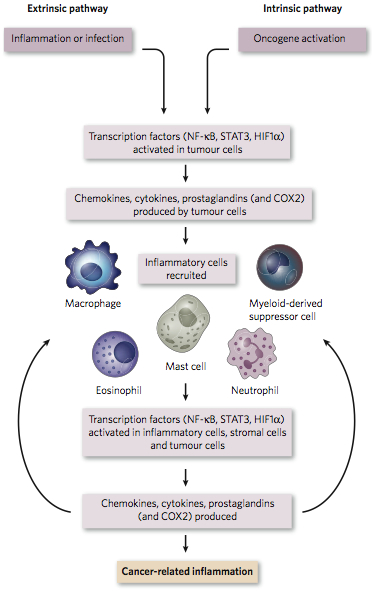
    At a high level, there are two pathways leading to cancer-related inflammation.

    extrinsic-intrinsic-pathways

    Credit: Mantovani et al, Nature 45|24, 2008

    In the extrinsic pathway, inflammatory conditions due to environmental factors (e.g. infection and carcinogen exposure) facilitate tumor development. Take lung cancer, for example. Exposure to tobacco smoke (which contains 10^15 to 10^18 free radicals per gram) often causes chronic obstructive pulmonary disease (COPD) and/or low-grade emphysema, both of which are chronic inflammatory conditions that increase risk of lung cancer. In mice, H. influenza induces COPD-like inflammation that promotes lung cancer driven by the KRAS oncogene.

    In the intrinsic pathway, somatic alterations in malignant cells activate signaling pathways that lead to the construction of an inflammatory micro-environment. In papillary thyroid carcinoma, for example, genomic rearrangements often activate the RET oncogene, which drives transcription of several inflammatory genes:

    • Interleukin-1β, one of the main pro-inflammatory cytokines
    • COX-2, which is involved in prostaglandin synthesis and up-regulated in many tumors
    • CCL2 and CCL20, chemokines that attract monocytes and dendritic cells
    • Chemokines IL-8 and CXCR4, which promote angiogenesis

    Key Players: NF-KB and STAT3

    Among the numerous molecules involved in cancer-related inflammation, transcription factors nuclear factor-kappaB (NF-κβ) and signal transducer activator of transcription 3 (STAT3) play pivotal roles. NF-κβ is a key orchestrator of innate immunity, activated by the toll-like receptor pathway (sensing microbes and tissue damage), as well as inflammatory cytokines TNF-α and IL-1β. Once activated, NF-κβ induces the expression of inflammatory cytokines, adhesion molecules, angiogenic factors, nitric oxide synthase, and COX-2. It also induces anti-apoptotic genes (i.e. Bcl-2), making it an attractive target for malignant cells. Indeed, NF-κβ expression is disregulated in many human cancers.

    The maintenance of NF-κβ expression in tumors requires STAT3. Not surprisingly, STAT3 is often constitutively activated in tumor cells. In colon cancer, it plays a central role in cell proliferation and survival by regulating c-Myc, cyclin D, Bcl-2, and other genes. In lung cancer, mutations in key oncogene EGFR lead to activating phosphorylation of STAT3. Also, mouse models of colorectal cancer have shown that knockout of STAT3 (either by genetics or pharmacologic inhibition) reduces tumor development.

    Tumor Recruitment of Immune Cells

    Some of the chemokines present in the tumor micro-environment serve to recruit certain immune cells, notably tumor-associated macrophages (TAMs) and myeloid-derived suppressor cells (MDSCs). TAMs are a major source of cytokine production in the tumor micro-environment, and also provide a number of growth-promoting factors. TAMs come in two kinds: M1 macrophages, which respond to interferon or microbe exposure, and express high levels of anti-microbial/anti-tumor cytokines (e.g. IL-1, IL-6, IL-12, and TNF); and M2 macrophages, which promote angiogenesis and tissue remodeling. Cytokines and cells in the tumor microenvironment influence whether TAMs become M1 or M2. Both NF-κβ and MDSCs promote polarization towards M2 macrophage, thereby stimulating angiogenesis and tissue remodeling favorable for tumor growth. MDSCs also induce the maturation of CD4+ T cells (T-regs), which suppress the immune response in protective fashion.

    The Role of Genetic Instability

    Inflammatory cells and molecules can destabilize the genomes of cancer cells through a variety of mechanisms. They induce the production of reactive oxygen species (ROS) and reactive nitrogen species (RNS), which can damage DNA by inducing double-stranded breaks. While cells have repair mechanisms for DSBs, they can be error prone. Further, nitric oxide and certain pro-inflammatory cytokines suppress TP53, which protects tumor cells from apoptosis triggered by DNA damage. IL-6, an inflammatory cytokine, promotes hypermethylation of tumor genomes by increasing DNA methyltransferase activity. Chronic inflammation has also been linked to disregulation of mitotic checkpoint proteins, which normally halt cell division until DNA damage is repaired.

    These mechanisms act in concert to destabilize cancer genomes, allowing somatic mutations and rearrangements to occur at an increased rate. This leads to a genetically heterogeneous population of tumor cells, which are under selection for their ability to proliferate, evade host defenses, and invade other tissues. Thus, cancer-related inflammation promotes tumor growth by accelerating the somatic evolution by which malignant cells arise.

    References
    David W. Kamp, Emily Shacter, Sigmund A. Weitzman (2011). Chronic Inflammation and Cancer: The Role of the Mitochondria. ONCOLOGY, 25 (5).

    Colotta F, Allavena P, Sica A, Garlanda C, & Mantovani A (2009). Cancer-related inflammation, the seventh hallmark of cancer: links to genetic instability. Carcinogenesis, 30 (7), 1073-81 PMID: 19468060

    Mantovani, A., Allavena, P., Sica, A., & Balkwill, F. (2008). Cancer-related inflammation Nature, 454 (7203), 436-444 DOI: 10.1038/nature07205

    AddThis Social Bookmark Button