RSS 2.0
  • Home
  • About
  • Aligners
  • Genomes
  • VarScan
  •  

    Cancer Versus the Immune System

    January 21st, 2011

    The human immune system is an incredible success story of evolution. It defends against a constant barrage of external threats – bacteria, viruses, and other pathogens – and, as I’ve recently learned, protects against an intrinsic threat: cancerous cells. In their review “Natural and Adaptive Immunity to Cancer“, Vesely and colleagues draw from recent mouse models of cancer and human clinical data to describe how cells, effector molecules, and pathways of the immune system act to suppress and control tumor cells. It’s not all good news, however. Apparently, certain immune system pathways (e.g. inflammation) instead serve to promote tumor growth.

    The Immune System Strikes: Senescence and Apoptosis

    Cells already have an array of intrinsic defense mechanisms that halt the transformation process. Numerous cellular proteins detect DNA damage and induce senescence, a permanent change of state characterized by morphological and gene expression changes. The activation of oncogenes, too, can trigger senescence. In fact, the hijacking of Ras signaling to escape senescence and proliferate is a key requirement for cell transformation. Alternatively, cells that sense injury or loss of mitochondrial integrity may undergo programmed cell death (apoptosis). This process may also be initiated externally by the ligation of tumor necrosis factor (TNF) family ligands to their corresponding receptors: TNF, TNF-related apoptosis-inducing ligand (TRAIL), and Fas ligand (FasL). There are still other, non-apoptotic paths to cell death (necrosis, autophagy, mitotic catastrophe) that are gaining attention as barriers to transformation.

    How the Immune System Prevents Cancer

    The immune system has three key responsibilities when it comes to preventing cancer:

    • Suppression of viral infections, which when unchecked can induce certain kinds of tumors
    • Timely elimination of pathogens, to reduce the extent and duration of inflammation, which often promotes tumorigenesis
    • Immunosurveillance, in which transformed cells are identified and destroyed before they can establish malignancy.

    The idea that the immune system might recognize and destroy tumor cells was conceived 50-100 years ago. This concept of “immunosurveillance” remained controversial, and saw little progress until the 1990′s. Does this story sound familiar? It’s much like the story of cancer and the metabolism, which also saw a long period of general ignorance before its “rediscovery” in the 1990′s. Mice get the credit for rekindling interest in the immune system’s tumor suppressor potential. Specifically, mice that were immunocompromised after loss of interferon (IFN) signaling or T-cell function. Such animals were significantly more susceptible to sarcomas after exposure to methylcholanthrene (MCA), implicating a role for the immune system in preventing these tumors in healthy mice.

    Over the last 10 years, work from many labs (including the authors’) has demonstrated how the immune system works to prevent outgrowth of many types of primary and transplanted tumors. The RAG2-knockout mouse, which is deficient in T-cells, B-cells, and natural killer (NK) cells, develops more spontaneous cancer lesions and is also more susceptible to MCA-induced sarcoma. Interestingly, a significant portion (40%) of tumors that develop in RAG2-knockout mice are rejected when transplanted to immunocompetent (wild-type) mice, demonstrating that normal immune system function successfully suppresses these cells. Sarcomas induced in wild-type mice (with MCA), however, grow unrestricted when transplanted to other mice. These observations suggest a dual role for the immune system: in wild-type mice, it protects against tumor development, but also edits the immunogenicity of developing tumors, allowing them to grow unimpeded when transplanted to healthy mice.

    The Three E’s: Elimination, Equilibrium, and Escape

    The authors have come to view immunoediting as a dynamic process with three distinct phases:
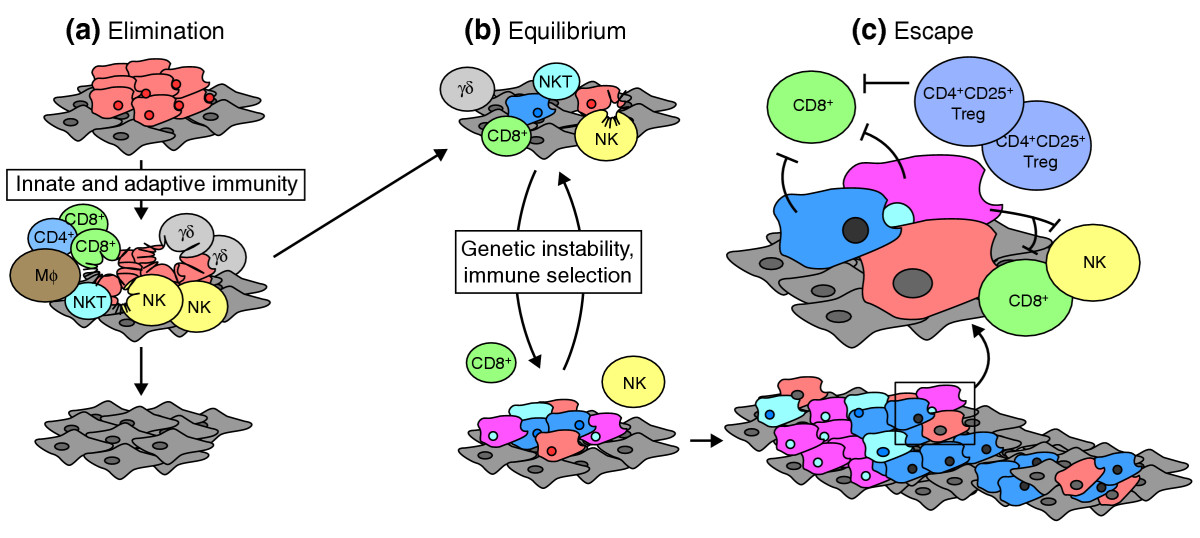
    Credit: Strausberg, Genome Biol. (2005) 6:211

    Credit: Strausberg, Genome Biol. (2005) 6:211

    1. Elimination, when innate and adaptive immune cells work together to identify and destroy tumor cells before a malignancy can form.
    2. Equilibrium, a phase when the immune system contains tumor outgrowth but does not eliminate transformed cells entirely.
    3. Escape, in which tumor cells grow unrestricted by the immune system, and develop into clinically apparent disease.

    Both elimination and equilibrium might be considered satisfactory clinical endpoints for a patient, because tumor cells are either destroyed entirely or held in check to prevent outgrowth of disease.

    The transition from equilibrium to escape is facilitated, at least in part, by the micro-evolution of the tumor cells during equilibrium. The selective pressure of immune recognition and destruction selects for tumor cells that are less immunogenic. Also aiding tumor escape is the breakdown of the immune system, either naturally (as a person ages) or as a direct result of immunosuppression (often induced by the tumor).

    The Mouse Evidence: Knockout and Induced Tumors

    Humans and mice have similar immune systems, with a largely overlapping repertoire of immune cells and effector molecules. The development of mouse strains deficient for specific genes, and the induction of tumors by carcinogens MCA (sarcoma) and DMBA/TPA (papilloma) have demonstrated that NK cells and cytotoxic lymphocytes (CTLs) suppress tumor initiation and growth in vivo. Interferon signaling also plays a key role in immunosurveillance, as demonstrated by the increased tumor susceptibility in mice lacking perforin, IFN-γ, IFNGR1, TRAIL, IL-12, TNF-α, and DNAM-1.

    Numerous cytokine molecules and receptors have also been implicated in controlling induced tumors. Mice deficient in IL-12, for example, develop increased numbers of papillomas than wild-type mice. Interestingly, mice lacking IL-23 or IL-17A are resistant to tumor development, suggesting a tumor-promoting role for these cytokines. Interestingly, DMBA/TPA exposure in mice lacking the TRAIL receptor did not affect the number of induced tumors, but did increase the rate of metastasis to lymph nodes (compared to wild-type mice), indicating a role for TRAIL-R in suppressing metastasis.

    Aging Studies and Spontaneous Tumor Development

    The incidence of spontaneous tumors in normal mice is very low, possibly because they have long telomeres. Many strains of immunodeficient strains fail to develop tumors even after two years of observation. Aging studies in knockout mice, however, have elucidated the roles of certain  genes, effector molecules, and immune cells in the defense against spontaneous tumors. This is an elegant type of experiment that requires some patience; one simply removes specific components of the murine immune system and monitors them for spontaneous tumor development. One striking discovery highlighted in this review was the incidence of immunogenic B-cell lymphomas, which increases from 0-6% in wild-type mice to 40-60% in mice lacking perforin, a cytolytic protein used by NK cells and T-lymphocytes. Penetrance of lymphomas in these mice is even higher when they also lack MHC class I accessory molecules (B2M) or IFN-γ. These observations support the importance of “cytotoxic” immune cells in protecting against spontaneous tumors.

    Aging experiments have also been performed in mice lacking specific immune cell types. RAG-2 knockout mice, for example, develop significantly more ephithelial tumors (35% gastrointestinal, 15% lung), even when raised on broad-spectrum antibiotics in a pathogen-free facility. RAG-2 knockouts that also lack STAT1, a key player in interferon I/II signaling, develop an earlier and broader spectrum of malignancy, including colon and mammary adenocarcinomas.

    Loss of Equilibrium

    The equilibrium phase, in which the immune system holds tumors in check but fails to eliminate them entirely, is an interesting phenomenon. Here we observe a dynamic balance between a powerful immune system response and a genetically heterogeneous population of tumor cells that can persist for a number of years. It has become clear that adaptive immunity, and not innate immunity, takes the lead in controlling tumor outgrowth. This has been demonstrated by experiments in which healthy mice are subjected to low levels of carcinogen exposure (which tends to induce few tumors) and later depleted for CD4+/CD8+ T-cells and/or IFN signaling. As many as 50% of apparently tumor-free mice develop sarcomas at the injection site upon this depletion, suggesting that micro-tumors were present but held in check by adaptive immunity. Granted, the tumors that arise after immunodepletion tend to be highly immunogenic; when transplanted to healthy mice, 40% are rejected by the competent immune response. In contrast, sarcomas obtained from mice that were not immunodepleted tend to grow progressively when transplanted.

    The Human Evidence: Immunodeficency and Immunosuppression

    Although we have fewer experimental liberties with human subjects, clinical and epidemiological data have proven useful. Human patients with specific perforin mutations, for example, not only develop familial hemophagocytic lymphohistocytosis as adults, but have recently been shown to also develop leukemia and lymphoma. Surveillance of human patients with AIDS has shown an increased frequency of several malignancies due to the immunodeficiency. Most often, these tumors are induced by pathogens, such as Epstein-Barr virus (lymphoma), herpesviruses (Kaposi’s sarcoma), and human papilloma virus (cervical cancer) that fail to be eliminated by the deficient immune system.

    Intentional immunosuppression in the recipients of organ transplants can also increase the risk of cancer. Patients receiving kidney transplants, for example, exhibit a three-fold increase in overall malignancy. Most of these, too, are virus-associated tumors, though there’s also an increased risk for colon, lung, pancreas, and other non-infectious cancers. Renal transplant patients are a dramatic example; these individuals have a 200-fold (yes, two hundred) risk for non-melanoma skin cancers, highlighting the importance of immunosurveillance in tumors induced by exposure to UV radiation. Further, the duration of pharmacology-induced imunosuppression and incidence of cancer are positively correlated; that is, the longer the immune system is suppressed, the more likely a tumor will form. Taken together, these observations support the importance of immunosurveillance in preventing human cancers.

    Further evidence of the immunity-cancer relationship, particularly the equilibrium phase, is offered by the occasional organ recipients who develop cancer that originated from the organ donor. I’m horrified to hear that this can happen, but it does. Often, the donors had died of other causes and bore no signs of clinically-detectable disease, suggesting that their immune systems had held cancerous cells in check. The combination of a naive immune system, and immunosuppressive therapies required for successful engraftment, allows these tumors to grow without restriction in the unfortunate recipient.

    Miracles Happen: Spontaneous Tumor Regression

    Perhaps the most compelling evidence for the anti-cancer role of the immune system is the spontaneous regression of melanoma tumors accompanied by T-cell clonal expansion. This phenomenon suggests the ability of CD4+ and CD8+ T-cells to identify tumor-specific antigens and destroy cancerous cells. As many as 100 tumor-associated antigens (TAAs) generate an antibody response in patient serum, though only 8 have been observed in multiple studies. This suggests that TAAs, much like somatic mutations, are largely unique to individual tumors. T-cell responses vary from antigen to antigen; for example, responses to MAGE family antigens are rare, whereas responses to melanocyte differentiation antigen (MART/Melan-A) are seen in >50% of healthy individuals.

    More studies are needed here to catalogue TAAs and quantify their antigenicity across patient populations. Here, too, is where high-throughput sequencing of tumor genomes might offer useful information as well. Knowledge of the full set of protein-coding mutations in a tumor might shed light on its immunogenic potential, or vice-versa, thereby leading to better informed prognoses and treatment decisions.

    Tumor-Infiltrating Lymphocytes and Disease Prognosis

    Even without complete tumor regression, the presence and quality of tumor-infiltrating lymphocytes (TILs) – NK cells, T-cells, and NKT cells – has a favorable prognosis for numerous tumor types. This correlation was first observed in melanoma, where patients with high CTL infiltration of their tumors survived longer. A “landmark” study in ovarian cancer found that 38% patients with high TIL numbers survived longer than 5 years, compared to 4.5% of patients with low TIL numbers. Studies in colon and lung cancers have found that the type and density of TILs was more powerful prognostic indicator than the clinical stage of the tumor.

    There is, of course, a downside to TILs: when they’re macrophages or regulatory T cells. High numbers of these can have a poorer prognosis, possibly due to their immuno-suppressive functions.

    Inflammation and Tumor Development

    Chronic inflammation can contribute to cancer by inducing genotoxic stress, cell proliferation, angiogenesis, and even enhancing tissue invasion. Even so, the tumor-promotion activities of inflammation and tumor-suppressing actions of the immune system are not mutually exclusive. In the authors’ mouse model of MCA sarcoma, for example, tumor development requires several inflammation molecules (MyD88, IL-10, IL1B,and IL-23), but these factors induce the host-protective immune response (IFN and T-cells) that destroy the tumors. In other primary carcinogen models, MyD88 and IL1B promote tumor development, but also facilitate the recognition of dying tumor cells that leads to anti-tumor immunity.

    Another important role of inflammation is the transition from equilibrium to escape, when inflammatory and regulatory immune cells are recruited to the tumor, and then subverted to dampen anti-tumor immunity, allowing cancer progression. Indeed, the authors suggest that pro-inflammatory transcription factors NF-KB and STAT3 may be valuable therapeutic targets, whose inhibition may facilitate the transition from tumor-promoting inflammation to tumor-suppressing immunity.

    References
    Vesely MD, Kershaw MH, Schreiber RD, & Smyth MJ (2010). Natural Innate and Adaptive Immunity to Cancer. Annual review of immunology PMID: 21219185
    AddThis Social Bookmark Button

    Driver Mutations and Metastasis

    November 30th, 2010

    Two recent papers used very different appraoches to shed light on the genetic alterations underlying tumor growth and progression in human cancers. Peter Campbell and colleagues from the Wellcome Trust Sanger Institute employed Illumina paired-end sequencing to survey the landscape of structural variation in metastatic pancreatic cancer. Ivana Bozic and colleagues from Harvard University took a different approach – they constructed mathematical models of tumor progression via the accumulation of driver and passenger mutations. I happened to read both papers on a long airplane ride, and learned a great deal about mutations and metastasis in human cancers.

    Pancreatic Cancer: Bad News

    You learn a lot from the introduction sections of these papers, even if the Letter to Nature format keeps them short. I knew that pancreatic cancer had, in general, a poor prognosis. It turns out that the five year mortality for this cancer is 97-98%, usually due to “widespread metastatic disease.” These tumors also appear to carry a heavy mutational load. A 2008 survey of 24 pancreatic cancers (by Bert Vogelstein’s group at Johns Hopkins) found that tumors had ~63 genetic alterations on average, the majority of which were point mutations. Copy number changes are also common in this cancer type. Frequently mutated genes include tumor suppressors (TP53, SMAD4, CDKN2A) as well as oncogenes (KRAS, MYC). Less was known about the patterns of structural variation in pancreatic cancer.

    Detecting Rearrangements by Paired-End Sequencing

    Peter Campbell’s group has developed a very nice strategy for identifying somatically acquired rearrangments by massively parallel paired-end sequencing on the Illumina platform. They’ve already applied it to the characterization of SVs in several cancer cell lines. In this study, they generated 50-150 million read pairs (2 x 37 bp) per patient, which, in their experience, enables detection of 50-60% of rearrangements in a sample. Across the 13 pancreatic tumors, they identified 381 somatic and 177 germline rearrangements across seven categories: amplicon, deletion, tandem duplication, inversion, fold-back inversion, interchromosomal (translocation), and “other” intrachromosomal.

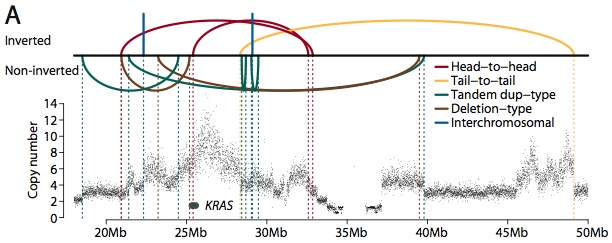
    Many rearrangements corresponded with a change in copy number. In one metastasis, for example, numerous rearrangements (some inverted, some not) combine to amplify the KRAS oncogene.

    Rearrangement/Amplification of KRAS (Credit: Nature).

    Rearrangement/Amplification of KRAS (Credit: Nature).

    Fold-back Inversions and Inter-Lesion Genetic Heterogeneity

    One sixth of the rearrangements identified fell into a class the authors call “fold-back” inversions. These are genomic regions that are duplicated, but the two copies face in opposite directions from the breakpoint (as opposed to a tandem duplication). The authors suggest breakage-fusion-bridge cycles as the likely mechanism that creates such an event. Basically, a double-stranded break that occurs during G0-G1 phase is replicated (in S phase), creating two duplicated end sequences. These are fused together by DNA repair processes, resulting in a sort of inverted duplication (fold-back inversion) with two centromeres. These “dicentric” chromosomes are unstable, and frequently initiate the amplification of oncogenes.

    Each rearrangement was [laboriously] genotyped by PCR in both the index tumor sample and matched normal control to verify the somatic status. Further, PCR and capillary sequencing were employed to resolve breakpoints, and some 206 rearrangements were genotyped across multiple lesions (metastases) in the 10 patients for which metastatic samples were available. There was a considerable amount of genetic heterogeneity among samples from the same patient. While the majority of rearrangements were present in all samples but not the germline (omnipresent); several were present in some samples but not others (partially shared) or unique to the index tumor sample (private).

    Telomere Loss and Breakpoint-Fusion-Bridge Cycles

    Fold-back inversions were significantly more likely than other classes of rearrangement to be omnipresent, suggesting that they occur early during tumor progression, before cancer cells disseminate. Because breakage-fusion-bridge cycles are often initiated by telomere loss, the activity of telomerase to maintain telomeres may play a pivotal role in the development of pancreatic cancer. Other studies have shown that telomerase expression is low in early tumor stages, but markedly increased in the invasive tumor. The increased expression likely suppresses breakage-fusion-bridge cycles, which may help explain why fold-back inversions are more likely to occur earlier in the development of the disease.

    Ongoing Evolution in Tumors and Mets

    In several patients, the authors found rearrangements that were in the primary tumor and some metastases, but not all of them. The most likely explanation for such a pattern is that the metastases were “seeded” by different cells from the primary tumor. This is intriguing, because it suggests ongoing clonal evolution, in the primary tumor, among cells capable of initiating metastases. There were also rearrangements in some metastases that weren’t detected in the primary tumor, suggesting that secondary lesions, too, are undergoing clonal evolution.

    Overall, the authors demonstrated that pancreatic cancers and secondary invasions show a substantial amount of genetic heterogeneity within the same patient. There’s certainly more to be done to get the full picture of genetic alterations in these tumors, but at just ~4-10 Gbp of data per sample, the scope and nature of what the authors have uncovered is pretty impressive.

    Drivers and Passengers

    The other paper (contributed by Bert Vogelstein to PNAS) took a theoretical approach to modeling the accumulation of driver and passenger mutations during tumor progression. In contrast to previous models that account for only 1-2 mutations, the authors develop a model in which mutations occur sequentially in tumor cells, with each new driver mutation conferring a slightly faster growth rate. This more closely reflects recently-characterized solid tumors, which harbor 40-100 coding gene alterations, of which 5-15 are considered “driver” mutations.

    Based on the assumption that any human cell contains 286 tumor suppressor genes and 91 oncogenes, the authors estimate that ~34,000 positions in the human genome could host a driver mutation. By this estimate, the driver mutation rate is approximately 3.4 x 10⁻⁵ per cell division. Under the authors’ assumption that each driver speeds tumor growth, the rate at which drivers accumulate becomes faster and faster, because the more drivers a cell has, the faster it divides. Not all mutations are successful, because they only reduce the probability that a cell will senesce or die (they don’t guarantee it). The authors considered a mutation in a tumor suppressor gene to be the central rate-limiting factor, since the other working copy tends to be lost relatively quickly due to large-scale LOH events.

    Six simulated patients were modeled and presented in this study. All of them started with one driver mutation. Strikingly, though all of the input values (mutation rate, division rate) were the same, there was enormous variation in the rates of tumor progression between simulated patients. Patient 1, for example, went 20 years before acquiring a second driver mutation, and the size of the tumor remained small (<5 g). In contrast, patient 6 had a secondary driver mutation in less than 5 years; by the end of the simulation, that tumor weighed hundreds of grams. While this model is undoubtedly an oversimplification, it does highlight the importance of, well, random chance. Given the large size of the human genome and the relatively small number of potential driver mutations, an individual’s fate hinges on stochastic processes. If you’re lucky, you go decades without picking up that crucial second hit. If you’re unlucky, you don’t.

    Intuitively, this seems reasonable, given the anecdotal evidence of de novo cancers, which seem to strike somewhat randomly. Of course, the older you are, the more times your cells divide, and the better chance you have of picking up additional driver mutations. And environmental exposures (like smoking and radiation exposure) certainly have a role to play, because they increase cellular mutation rates. Even so, if you believe in the model, chance plays a significant role.

    Here’s to hoping you’re one of the lucky ones.

    References

    Bozic I, Antal T, Ohtsuki H, Carter H, Kim D, Chen S, Karchin R, Kinzler KW, Vogelstein B, & Nowak MA (2010). Accumulation of driver and passenger mutations during tumor progression. Proceedings of the National Academy of Sciences of the United States of America, 107 (43), 18545-50 PMID: 20876136

    Campbell PJ, Yachida S, Mudie LJ, Stephens PJ, Pleasance ED, Stebbings LA, Morsberger LA, Latimer C, McLaren S, Lin ML, McBride DJ, Varela I, Nik-Zainal SA, Leroy C, Jia M, Menzies A, Butler AP, Teague JW, Griffin CA, Burton J, Swerdlow H, Quail MA, Stratton MR, Iacobuzio-Donahue C, & Futreal PA (2010). The patterns and dynamics of genomic instability in metastatic pancreatic cancer. Nature, 467 (7319), 1109-13 PMID: 20981101

    AddThis Social Bookmark Button

    Cancer Genomics Meeting in St. Louis

    December 3rd, 2009

    The Genome Center at Washington University is currently hosting a remarkable two-day event focused on the study of cancer genomics.  Yesterday there was a symposium on the School of Medicine campus, featuring speakers from major genome centers around the world, who delivered an excellent series of talks on recent advances in cancer genome research.  Here were the highlights.

    Mutational Signatures in Lung Cancer (Peter Campbell, WTSI)

    First up was Peter Campbell from Wellcome Trust Sanger Institute, who presented their first cancer genome – a small lung cancer cell line called NCI-H209.  Using the ABI SOLiD platform, they sequenced NCI-H209 and a matched B-cell sample from the same individual to 30-40x coverage.  Extensive PCR-based validation yielded almost 23,000 somatic substitutions and over a hundred structural events (indels and rearrangements).  As expected, the mutational spectrum was enriched for G->T and C->A changes associated with adduct formation on guanine nucleotides induced by benzopyrene, the chemical mutagen found in tobacco smoke.  Dr. Campbell also described some of the complex rearrangements observed in the paired-end sequencing data, which were particularly convincing when overlaid with spectral karyotyping images.

    Next-Gen Sequencing Strategies to Study Cancer Genomes (Elaine Mardis, WU)

    Next was our own Elaine Mardis, who gave an excellent overview of the strategies developed here to apply NGS to cancer genomes.  She described five key elements to success in this arena:

    1. Genomic characterization prior to sequencing. For example, at WashU we type tumor and normal samples on genome-wide SNP arrays, which yield tumor purity/ploidy estimates, LOH information, and a dense set of SNPs for tracking the coverage of genomes by Illumina sequencing.
    2. Resource characterization. The tissue preservation method, DNA/RNA quality and quantity, and pathology information are all critical components.  Also important are high-quality clinical data (diagnosis, chemotherapy/radiation protocols, and outcome), informed consent, IRB approval, and additional cases of the same cancer subtype for recurrency screening.
    3. Data production capacity.  US genome centers seem to have this, either in the form of Illumina (WashU and Broad) or ABI SOLiD (Baylor).  It’s not just the throughput of the machines, either – it’s the ability to construct sequencing libraries from ever-shrinking DNA inpus.  Tumor samples are precious, and the ability to use only a tiny amount of DNA or RNA while achieving informative results is one of the key areas of focus of tech development groups.
    4. Informatics and bioinformatics.  We have entire groups devoted to LIMS, pipeline automation, medical genomics, and sequence data submission.  Other important elements of bioinformatics that Elaine touched on were data display interfaces for collaborators and high-end data storage and computational infrastructure.
    5. Validation and recurrent site screening.  This the essential coup de grace for tumor genome characterization, in which we validate somatic mutations and identify those that are recurrent in other samples of the same subtype, the best indication that we currently have of pathological relevance.

    Elaine also discussed the rapid scaling up of TCGA (which is adding 20 tumor types thanks to ARRA funds) and other projects, which will only exacerbate the challenges of scale that NGS platforms have already presented.

    Integrating Genomics with Biology (Richard Gibbs, Baylor)

    Richard Gibbs gave an action-packed talk of some relevant work going on at Baylor, both for cancer and inherited diseases.  They are applying an intriguing if controversial multiple-platform strategy for whole genome sequencing: deep (20-30x) coverage on ABI SOLiD and light (6-10x) coverage on 454. “We’re just telling people that if you do it twice, you’ll get it right,” Dr. Gibbs said.  One interesting project is an investigation of Charcot-Marie Tooth (CMT) syndrome, a recessive inherited disorder where the locus is unknown.  Whole-genome sequencing of an affected individual on ABI SOLiD identified a few dozen novel missense mutations; among them lurked the causal variant, which was found to segregate with the disease in a family cohort.

    Dr. Gibbs also gave an overview of their investigations into heritable variants in pediatric cancers (in collaboration with MD Anderson).  There’s also a lot of work under way for TCGA, not just the 6K capture project, but also adjunct analyses of gene expression, DNA copy number, microRNA, and DNA methylation data being generated on TCGA samples.

    Insights into Rare Tumors (Steven Jones, BC Cancer Agency)

    Steven Jones from BC Cancer Agency retold the story of the rare tongue adenocarcinoma that I heard at AGBT 2009.  What I didn’t know about BCCA is that under the Canadian universal healthcare system, they see all of the cancer patients in the surrounding population of over 4 million citizens.  One of these was a rare one – an 80 year old man with adenocarcinoma of the tongue.  It was removed surgically, of course, but in a short time metastasized to the lungs.  The clinician prescribed erlotinib, an EGFR inhibitor, but unfortunately the patient did not respond.  To help the patient, and also make some advances in tech development, Jones and his colleagues did whole-genome and RNA-Seq of the tumor samples and matched normals.  There were just four somatic mutations: two in known cancer genes and two in zinc finger proteins (these remain unexplained).  Transcriptome and copy number analysis showed that the tumor had loss of PTEN and down-regulation of SMAD4.  Unfortunately, it had recently been shown that tumors lacking PTEN and TP53 don’t respond to TK inhibitors like erlotinib.  However, this particular tumor showed an amplification of Ret, and as it happened, the drug bank had a single drug, sunitinib, that was known to inhibit Ret.  The patient’s response, initially, was quite dramatic – all of the metastases vanished.  Sadly, several months later they turned up again, and this time were resistant even to sunitinib.  Still, the results of this effort were promising, because genomic information was used to keep cancer at bay, if only for a short time.

    Genomic Medicine in Pediatric Brain Tumors (Chinc C. Lau, Baylor)

    Ching Lau of Baylor presented genomic studies of medulloblastoma (MBM), which accounts for 20% of all brain tumors and has a 60% survival rate.  Classification of MBM patients in the past was relatively crude – based on the amount of residual tumor post-surgery and metastatic status. Using gene expression profiling, Lau and colleagues identified 4-5 distinct clusters.  Two clusters were associated with known cancer pathways – SHH signaling and WNT activation. The same four clusters could also be isolated by unsupervised miRNA clustering. Also, gene expression analysis showed that ERBB2 expression correlates with outcome (higher expression = poor prognosis).

    Finally, Dr. Lau mentioned some future directions for targeted cancer therapy.  One of these that I readily admit I don’t understand: cytotoxic T-cells with Chimeric TCRs. Evidently these are T-cells that recognize and attack cancer cells in the body.  There was a short movie, courtesy of Dr. Lau’s collaborators, in which we saw these specially programmed immune cells recognizing and attacking a tumor that was roughly four times their size.  It was like watching ants swarm a piece of fruit on the sidewalk, and very compelling.

    Evolution of a Breast Cancer Tumor (Samuel Aparicio, BC Cancer Agency)

    Dr. Aparicio presented a study recently published in Nature and already discussed on Massgenomics.  However, he did discuss the continuing challenge of mutation heterogeneity in tumors – we can no longer refer to mutations as present or absent, but instead should report their frequency, which represents the proportion of clones with each mutation.  The question of how deep we need to sequence to find the very rare variants has yet to be answered.

    Breast Cancer Genomics (Matthew Ellis, Siteman Cancer Center)

    Matthew Ellis, our collaborator from the Siteman Cancer Center, presented very recent work we’ve done on a basal subtype breast cancer.  A quartet of samples were sequenced in this study – the primary breast tumor, the matched normal tissue, the brain metastasis (from which the patient died), and finally, a mouse xenograft model developed in “humanized” NODSCID mice.  We validated some 50 tier 1 mutations, all of which were detected (at some level) in all four samples.  Deep read counts for these mutations in each sample revealed some interesting stories about the progression of the cancer from tumor to metastasis.

    Genomic Signatures and Cancer  (Todd Golub, Broad / Dana Farber)

    Todd Golub of the Broad Institute and Dana Farber Cancer Center presented his group’s work on Hepatocellular Carcinoma (liver cancer), which is the fifth most common cancer worldwide.  It’s a disease of growing concern on the African and Asian continents, and presents numerous challenges.  Molecular classification “is a mess,” Dr. Golub said, and recurrence is common.  The problem is that there are few frozen samples with long-term outcome information.  Thus, Dr. Golub and his group applied the Illumina DASL assay – which enables very small, highly multiplexed, locus-specific PCR – to perform expression profiling in formalin-fixed paraffin-embedded (FFPE) samples.  They achieved up to 90% success across 6,000 genes in samples that were 25 years old.  Doing so opened up a vast bank of viable samples for gene expression profiling, from which Dr. Golub and colleagues made some interesting findings.

    The AML Genome (Tim Ley, WashU and Siteman Cancer Center)

    Tim Ley gave the last talk, which highlighted the work that he and colleagues at WashU began around a decade ago on the disease acute myeloid leukemia (AML).  Our goal, he said, was to find 95% of the mutations that occur in at least 5% of AMLs.  To do so will require whole genome sequencing of at least 30 genomes, according to statistics from my colleague Mike Wendl.  Two of these (AML-1 and AML-2) are already done and published, and a number of others are currently under way.  One intriguing bit of work that Dr. Ley described was on the “Mouse APL” project, a knock-in mouse with the PML-RARA gene fusion backcrossed 10+ generations to CBL/BL6 mice.  This yielded inbred strains of mice, some of which developed AML after ~6 months, presumably after acquiring “cooperative” mutations.  One mouse was sequenced to 15x coverage, and among the handful of somatic nonsynonymous mutations found, one was recurrent, not only in the APL mice, but also in the same gene in human tumors.

    AddThis Social Bookmark Button

    First Breast Cancer Genome in Nature

    October 9th, 2009

    October is Breast Cancer Awareness Month, and the timing couldn’t be better.  Our friends at the BC Cancer Agency published the whole genome sequencing of a breast cancer this week in a letter to Nature.

    Nature Vol 461 | 8 October 2009

    Nature Vol 461 | 8 October 2009

    Using Illumina paired-end sequencing, Shah et al generated 141 Gbp of sequence to achieve 43x haploid coverage of a metastatic lobular breast cancer.  Some 32 somatic, protein-altering (nonsynonymous) mutations were identified, of which 11 could be detected in the primary tumor sample from 9 years earlier.  Deep RNA-Seq data from the metastatic sample also permitted transcriptome analysis, though its presentation was brief.  Interestingly, the authors validated two novel RNA-editing events that change the amino acid sequences of SRP9 and COG3.

    No WGS of Normal or Primary Tumor?

    I realize that a letter to Nature must be brief, but even so, what struck me most about this paper is what’s missing.  First of all, only the metastatic sample was whole-genome sequenced – the primary tumor and matched normal were not.  Instead, the authors identified nonsynonymous coding variants in met WGS data, and validated them by PCR/3730 sequencing in the met, tumor, and normal samples.  This seems laborious to me, since there were 1,120 nonsynonymous SNVs, of which 437 (39%) were valid and only 32 (<3%) were absent in the normal and therefore somatic.  Another regrettable limitation of this approach is that it doesn’t offer a complete picture of the somatic mutations beyond nonsynonymous-coding events.

    Missing Methods

    My understanding of Nature journals is that there’s no limit on supplementary material that accompanies publications.  Thus, I don’t understand why the methods are incomplete.  For example, though the authors found and confirmed >60 germline indels, there’s no description anywhere of the indel-calling algorithm.  There’s a lot of text describing their internally developed SNVmix algorithm to identify SNVs, but no link to download it that I could find.  No mention of dbSNP or Affy SNP array concordance for SNVmix calls was offered, so one cannot evaluate the algorithm.  Also, there’s no description of read de-duplication, which is alarming because it suggests that duplicate reads from the same molecule weren’t removed prior to analysis.

    The Importance of RNA-Seq

    I do like that the authors performed RNA-Seq of the transcriptome, which provides insights into mechanisms like alternative splicing (AS), allele-specific expression (ASE), and RNA editing.  Sadly, only the last one received mention in the results section, suggesting that no significant AS or ASE events were found.  Interestingly, not only did the authors validate two instances of high-frequency, protein-altering RNA editing (COG3 and SRP9), but they found that the ADAR RNA-editing enzyme was one of the most highly expressed genes in the metastasis. The authors note that “these observations emphasize the importance of integrating RNA-seq data with tumor genomes,” although this claim would have been far better supported if one did not have to dig through a massive/disorganized Excel file for most of the RNA-seq data.

    “Evolution” of a Breast Cancer Tumor

    Perhaps the most intriguing – and contentious – finding of the paper (as highlighted by GT’s In Sequence magazine and Keith Robison on Omics Omics) was that few of the somatic mutations in the metastasis were detected in the primary tumor sample from 9 years earlier.  PCR and deep resequencing of mutation-containing amplicons in the metastasis and primary tumor allowed for a frequency analysis of the 32 somatic mutations.  Five of these (in ABCB11, HAUS3, SLC24A4, SNX4, and PALB2) were present at high levels in the primary tumor, while another six (in KIF1C, USP28, MYH8, MORC1, KIAA1468, and RNASEH2A) were detectable at lower frequencies (1-3%).  Of the remaining 21 mutations, 19 were not detected at all and 2 could not be determined.

    I’m not an oncologist, but I still wonder how surprising it should be that many of the mutations in a metastatic tumor are absent from a primary tumor almost a decade earlier.  Are these simply passenger mutations that arose from a surviving subclone from the original tumor, or are they key drivers of metastasis and tumor growth? Or was it the intervening radition and therapy that caused these mutations?  There was zero discussion of the known functions of these genes in this paper, so it’s difficult to say.  The authors contrast this result with our sequencing of AML1, though I’m not sure it is an appropriate comparison since (1) we had data from a relapse 3 years post-diagnosis, whereas theirs was from a metastasis 9 years post-diagnosis.  Even so, the findings in the breast cancer study are interesting enough to merit further investigation.

    References
    Shah, S., Morin, R., Khattra, J., Prentice, L., Pugh, T., Burleigh, A., Delaney, A., Gelmon, K., Guliany, R., Senz, J., Steidl, C., Holt, R., Jones, S., Sun, M., Leung, G., Moore, R., Severson, T., Taylor, G., Teschendorff, A., Tse, K., Turashvili, G., Varhol, R., Warren, R., Watson, P., Zhao, Y., Caldas, C., Huntsman, D., Hirst, M., Marra, M., & Aparicio, S. (2009). Mutational evolution in a lobular breast tumour profiled at single nucleotide resolution Nature, 461 (7265), 809-813 DOI: 10.1038/nature08489

    AddThis Social Bookmark Button